

How to Launch a Research Journal: A Practical Roadmap for Publishers
Planning how to launch a research journal? This guide covers editorial setup, peer review, ISSN, DOI, and launch timing - with support from ScholarJMS.
How to Launch a Research Journal: A Practical Roadmap for Publishers There's a meaningful difference between building the infrastructure for a re...
How to Launch a Research Journal: A Practical Roadmap for Publishers
There's a meaningful difference between building the infrastructure for a research journal and actually launching it. Building covers the groundwork - scope, editorial board, policies, website. Launching is the act of putting that groundwork into motion: opening submissions, running your first peer-review cycle, and publishing a first issue that represents your journal to the world for the first time.
Many editorial teams get the groundwork right but stumble at the launch stage - opening submissions before policies are finalized, publishing a thin first issue just to hit a self-imposed deadline, or going live without a clear plan for promoting the new journal to the researchers who'd actually want to submit to it. Understanding how to launch a research journal properly means treating the launch itself as a distinct phase with its own sequence and its own risks, not just the final step of setup.
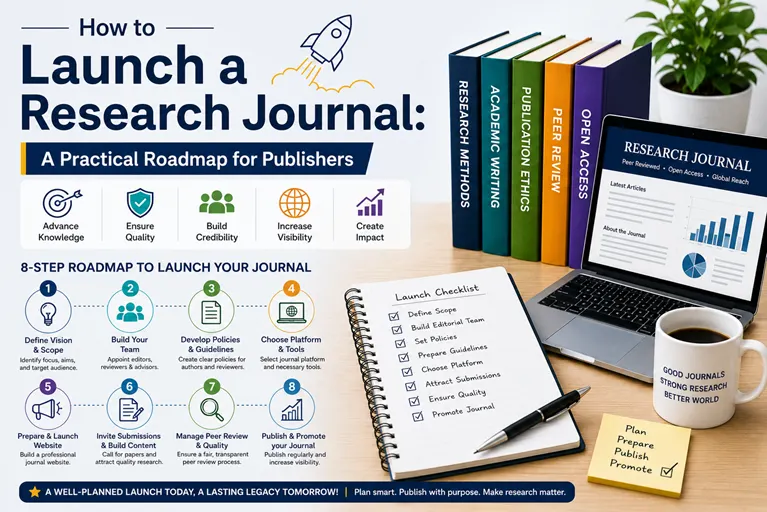
This guide focuses specifically on that launch phase - what needs to be finalized before you open submissions, how to sequence your first review cycle, and what a realistic first-issue launch actually looks like. It also touches on where journal management platforms such as ScholarJMS and Crossref DOI support fit into a smooth launch process.
What Does "Launching" a Research Journal Actually Mean?
Launching is the point at which a journal moves from internal preparation to public operation. Before launch, decisions about scope, editorial board, and policy are largely internal - they can be revised freely without affecting anyone outside the founding team. After launch, those same decisions become public commitments. Authors submit based on your stated scope; reviewers agree to serve based on your stated review process; readers cite your first issue based on the quality bar you set.
This is why a rushed launch tends to create long-term friction. A journal that changes its scope significantly after opening submissions, or that publishes an inconsistent first issue, spends its next several issues repairing the impression that launch created. A well-sequenced launch, by contrast, gives the journal a stable foundation to build a publication history on.
Pre-Launch: What Needs to Be Finalized First
Before opening submissions publicly, a handful of things need to be locked in, not just drafted.
Your aims and scope statement should be final, not a working draft - because once authors start submitting against it, changing it creates inconsistency in your first issue's content. Your editorial board should be confirmed and listed publicly, with roles clearly assigned, since authors and reviewers will expect to see who is actually running editorial decisions. Your core policies - peer-review model, publication ethics, plagiarism handling, copyright and licensing - should be published on your website, not held as internal documents, since authors need to know these terms before they submit.
Your submission and review infrastructure should be tested before it's opened to the public. This means running at least one internal test submission through your journal management system to confirm the workflow actually functions as intended, rather than discovering gaps once real manuscripts are in the pipeline.
How to Launch a Research Journal: The Sequence
Step 1: Soft-Open Submissions to a Known Network
Rather than opening submissions broadly on day one, many successful launches start by inviting a small number of known, trusted researchers - often from the editorial board's own networks - to submit early manuscripts. This gives the editorial team a controlled first batch to test the review workflow against, without the pressure of an unpredictable public submission volume.
Step 2: Run a Full Review Cycle End to End
Take at least one manuscript completely through the process - screening, reviewer assignment, review, revision, and final decision - before treating the workflow as production-ready. This surfaces gaps that are easy to miss on paper: unclear reviewer instructions, ambiguous revision timelines, or decision communication that doesn't match what your published policy describes.
Step 3: Open Public Submissions
Once the workflow has been tested and refined, open submissions publicly through your journal website and management system. At this stage, make sure your author guidelines, submission portal, and scope statement are all consistent with each other - mismatches here are a common source of early author confusion.
Step 4: Build Toward a Credible First Issue
Rather than publishing whatever happens to be ready by an arbitrary date, aim for a first issue that genuinely reflects your intended scope and quality bar. A smaller, well-reviewed first issue tends to serve a new journal better than a larger one padded with weaker submissions just to hit a target article count.
Step 5: Assign DOIs and Finalize Metadata
Before publishing, make sure each article has complete metadata - author details, abstract, keywords, and references - and that DOI assignment through your registration agency (such as Crossref) is completed correctly. Metadata errors at this stage are difficult to correct after publication and can affect how easily articles are found and cited later.
Step 6: Publish and Announce
Publish the first issue on your journal website, and announce it through the channels most relevant to your target research community - professional networks, relevant academic societies, and direct outreach to researchers in your subject area. A quiet launch with no announcement tends to slow the journal's early growth unnecessarily.
Building a Realistic Launch Timeline
A common mistake in journal launches is setting an aggressive public deadline before the underlying editorial process is actually ready. It's generally more effective to sequence backward from readiness rather than forward from a fixed date: confirm your editorial board and policies first, test your workflow second, run a soft-open submission phase third, and only then commit to a public launch date for your first issue.
The overall timeline varies significantly based on how quickly manuscripts become available, how responsive your reviewer pool is, and how much of your infrastructure is already configured through an existing journal management platform versus built from scratch. Journals that use a structured platform such as ScholarJMS during this phase are often able to compress the infrastructure-related delays, since submission handling, reviewer coordination, and metadata workflows are already built into the system rather than needing custom development.
Common Launch Mistakes to Avoid
A frequent issue is opening public submissions before the review workflow has actually been tested, which leads to inconsistent handling of the earliest manuscripts. Another is publishing a first issue that doesn't clearly reflect the stated scope, which confuses future authors about what the journal actually accepts. Some journals launch without finalized policies, then have to retroactively apply rules to manuscripts that were already submitted under different, unstated expectations.
It's also common for new journals to under-invest in launch promotion, assuming that publishing on a website is sufficient to attract submissions - in practice, direct outreach to relevant researchers tends to matter far more in the early stages than passive discoverability. Finally, some journals make premature claims about indexing or database inclusion in their launch announcements; since indexing decisions are made independently by each database based on an established track record, it's more accurate - and more credible - to describe indexing as a future goal rather than an existing status.
How ScholarJMS Supports a Research Journal Launch
The launch phase involves coordinating several moving parts at once - submission intake, reviewer assignment, manuscript tracking, and metadata preparation - often under real time pressure as the first issue comes together. ScholarJMS, as an academic journal management and publishing platform, is built to support exactly this kind of coordination.
During a launch, a platform such as ScholarJMS can support manuscript submission handling for your soft-open and public submission phases, editorial workflow tracking so reviewer assignments and decisions stay organized, and peer-review management that keeps your review cycle consistent from the very first manuscript. It also supports article and issue management as you assemble your first issue, along with metadata handling to help keep DOI and citation information accurate from the outset.
Using a structured platform during launch doesn't remove the need for careful editorial planning - it gives the editorial team a consistent operational foundation to execute that plan on, rather than improvising processes in real time as the first submissions arrive.
Frequently Asked Questions
How do I launch a research journal? Launching a research journal involves finalizing your scope, editorial board, and policies, testing your review workflow with a soft-open submission phase, then opening public submissions and publishing a first issue that reflects your intended quality standard.
What's the difference between building and launching a journal? Building refers to setting up the underlying infrastructure - scope, editorial board, policies, website, and systems. Launching is the process of putting that infrastructure into public operation, starting with submissions and ending with a published first issue.
Should I open submissions immediately or test the workflow first? It's generally more effective to test your review workflow with a small, controlled batch of submissions before opening publicly, so process gaps are identified before they affect a larger volume of manuscripts.
How big should a first issue be? There's no fixed number - a smaller first issue that genuinely reflects your journal's scope and quality bar is generally more valuable than a larger one padded with weaker submissions to hit an arbitrary article count.
Do I need an ISSN before launching? An ISSN is generally expected for formal recognition as a periodical and is often required for indexing consideration, so it's advisable to have this in progress or finalized before your public launch, though specific requirements vary by country.
Can a new journal claim to be indexed at launch? No. Indexing in databases like DOAJ, Scopus, or Web of Science is decided independently by each service based on an established publication track record. A new journal should describe indexing as a goal it's working toward, not a current status.
How can ScholarJMS help during a journal launch? ScholarJMS supports manuscript submission handling, editorial workflow tracking, peer-review coordination, and article and issue management during the launch phase, giving editorial teams a consistent system to run their first submission cycles on.
How long does it typically take to go from setup to launch? This varies based on manuscript availability, reviewer responsiveness, and how much infrastructure is already in place through an existing journal management platform; sequencing readiness before setting a public date tends to produce a smoother launch than working backward from a fixed deadline.
CTA Block:
Planning Your Research Journal Launch?
If you're preparing to launch a new research journal—finalizing your editorial workflow, setting up a journal management system, or configuring DOI registration through Crossref—our team can help you put the technical and operational pieces in place for a professional publishing workflow.
Mr. Darshan Patel (ME-CE)
COO & Journal Publishing Technology Consultant
Sequence Research & Development Pvt. Ltd.
Ahmedabad, Gujarat, India
📧 Email for Journal Setup & Crossref DOI: inquiry@ojscloud.com
📱 WhatsApp for Journal Setup & Crossref DOI: +91 82003 85143